 capodichino
No direct link: the journey has two halves
There is no boat from Naples airport. Every island journey is the same shape: airport to the port, then port to island. Each half is simple. What catches people out is the join between them, and almost always for one of two reasons — arriving at the wrong pier, or leaving too little time after the plane lands.
The good news is that the airport is unusually close to the port for a major city: about 35 minutes by bus. The bad news is that the boats stop earlier in the day than most people expect, and in winter some crossings thin out to a handful a day.
Half one: airport to the port
Three ways, all of them short.
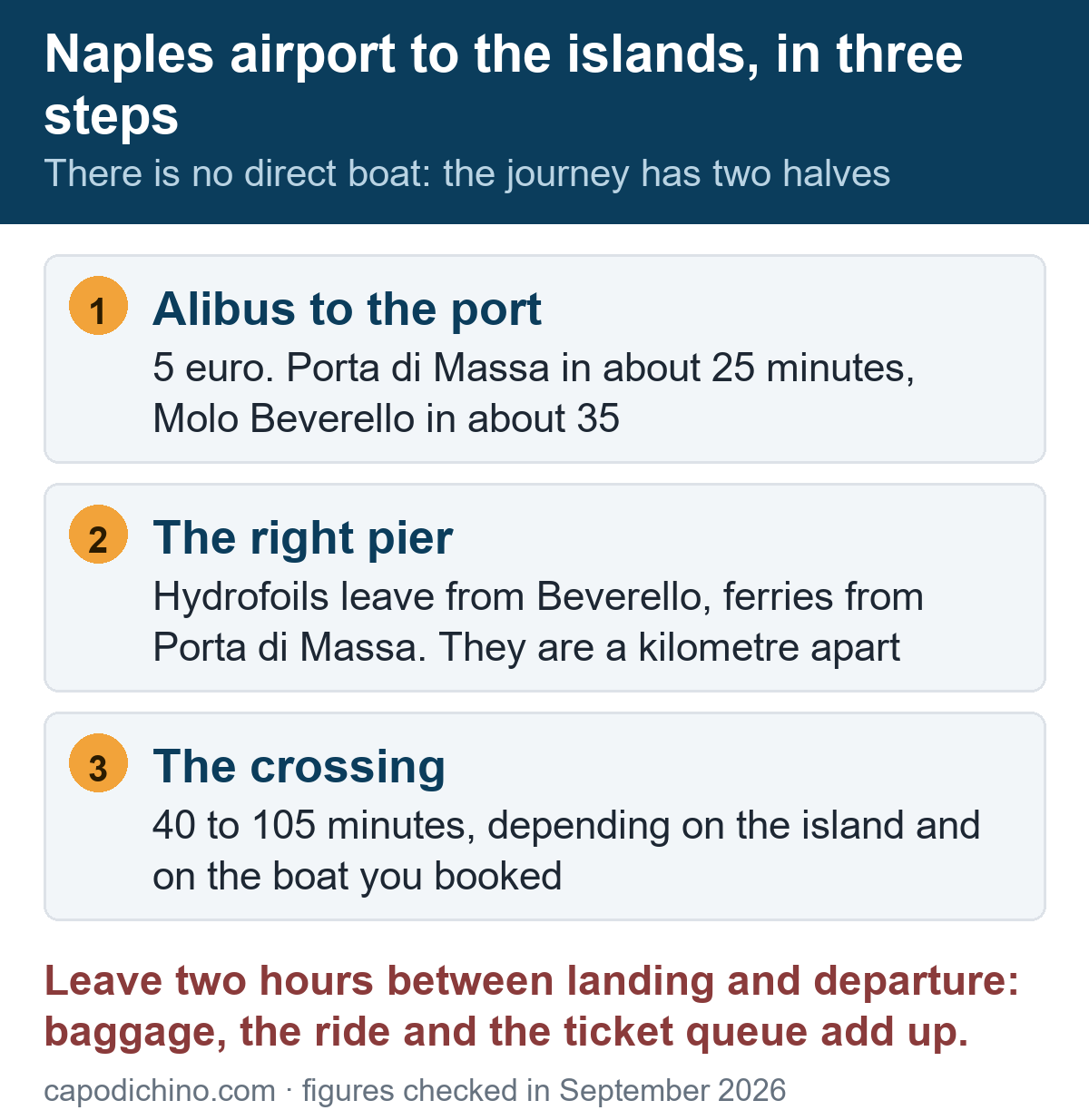
- Alibus, the airport shuttle, 5 euro per person. It stops at Immacolatella/Porta di Massa after about 25 minutes and at Molo Angioino/Beverello after about 35. It is the cheapest option and it goes to both piers, which no other service does.
- Taxi, flat fare 24 euro to the port, Molo Beverello or piazza Municipio. Fixed by the city, so there is no meter to argue about. For two or more people with luggage it is worth the difference.
- Private transfer, booked in advance, above taxi level. It makes sense on a late arrival or with a lot of luggage, because the driver tracks the flight and waits.
Full detail on all three, with timetables and where to buy tickets, is in our guide to Naples airport and the city centre.
The mistake that costs people the boat: there are two ports
This is the single most useful thing on this page.
Naples has two separate passenger piers, about one kilometre apart, and they are not interchangeable:
- Molo Beverello — hydrofoils. Fast, passengers only, no vehicles.
- Calata Porta di Massa — ferries, including the ones that carry cars.
A free shuttle connects the two, but "free shuttle" is not the same as "instant": if you land at Beverello with a ferry ticket from Porta di Massa and twenty minutes to spare, you will be running.
Check your ticket before you get off the Alibus. It says which pier. The Alibus stops at Porta di Massa first, ten minutes before Beverello — so if your boat leaves from Porta di Massa and you stay on the bus, you have thrown away ten minutes and a kilometre.
Capri: the fastest and the cheapest
Capri is the busiest of the three routes and has the widest choice of boat.
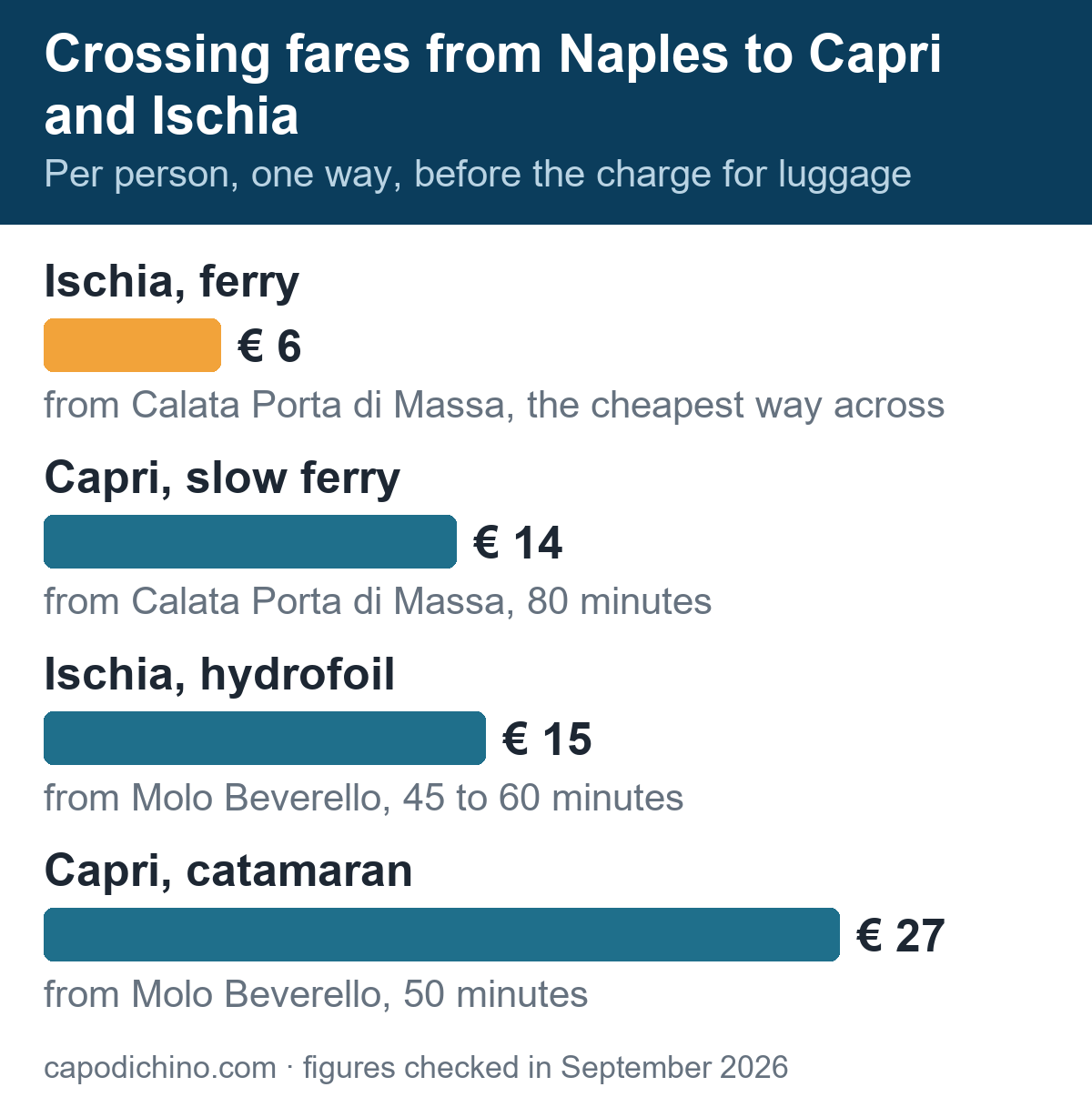
| Type | Leaves from | Crossing | Fare |
|---|---|---|---|
| Slow ferry | Calata Porta di Massa | 80 minutes | 14-19 euro |
| Ferry | Calata Porta di Massa | 60 minutes | about 25 euro |
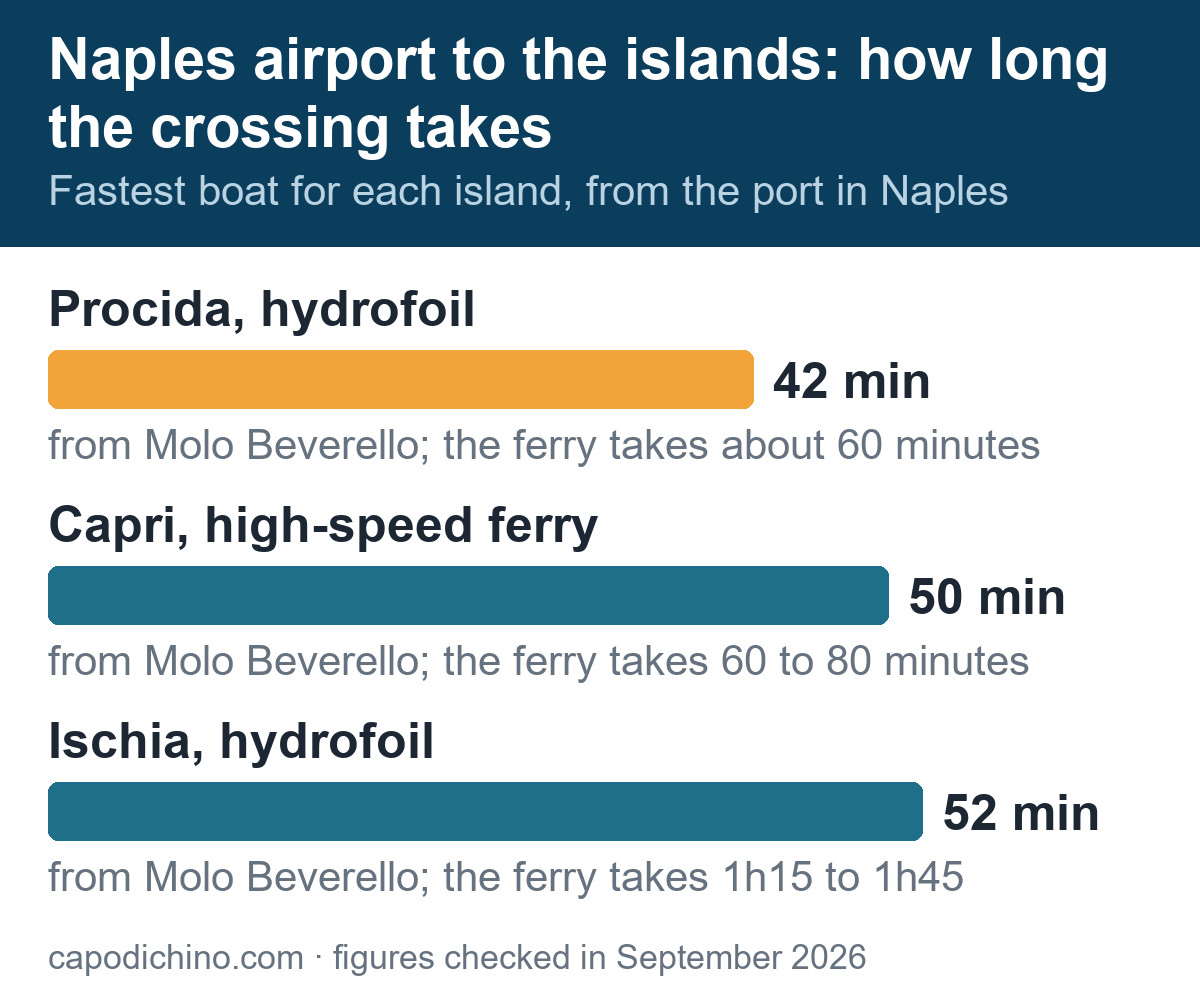
| High-speed ferry, catamaran | Molo Beverello | 50 minutes | 26,50-31 euro |
Add about 2 euro per bag on most services. First departures start around 04:00 on some weekday ferries; the last crossings of the day are generally in the early evening, around 20:00 in high season and earlier in winter.
The half-hour you save on the hydrofoil costs roughly double. With a early-afternoon flight and no hurry, the slow ferry is the better deal and the more comfortable crossing in rough weather.
Ischia: the cheapest crossing of the three
Ischia is the one where ferry and hydrofoil differ most in price.
| Type | Leaves from | Crossing | Fare from |
|---|---|---|---|
| Hydrofoil | Molo Beverello | 45-60 minutes | about 15 euro |
| Ferry | Calata Porta di Massa | 1h15 - 1h45 | about 6 euro |
| Ferry | Pozzuoli | about 1 hour | varies |
Taking a car over costs 35-55 euro for a vehicle under four metres, more for larger ones and campers.
Two things to check on the ticket. First, Ischia has three arrival ports — Ischia Porto, Casamicciola and Forio — and they are not close to each other: landing at Forio when the hotel is in Ischia Porto means a bus or a taxi across the island. Second, the Pozzuoli departure is not reachable by Alibus: it is a separate journey from the airport and only makes sense if you are already out that way.
Procida: the short one
Procida is the closest island and the simplest crossing.
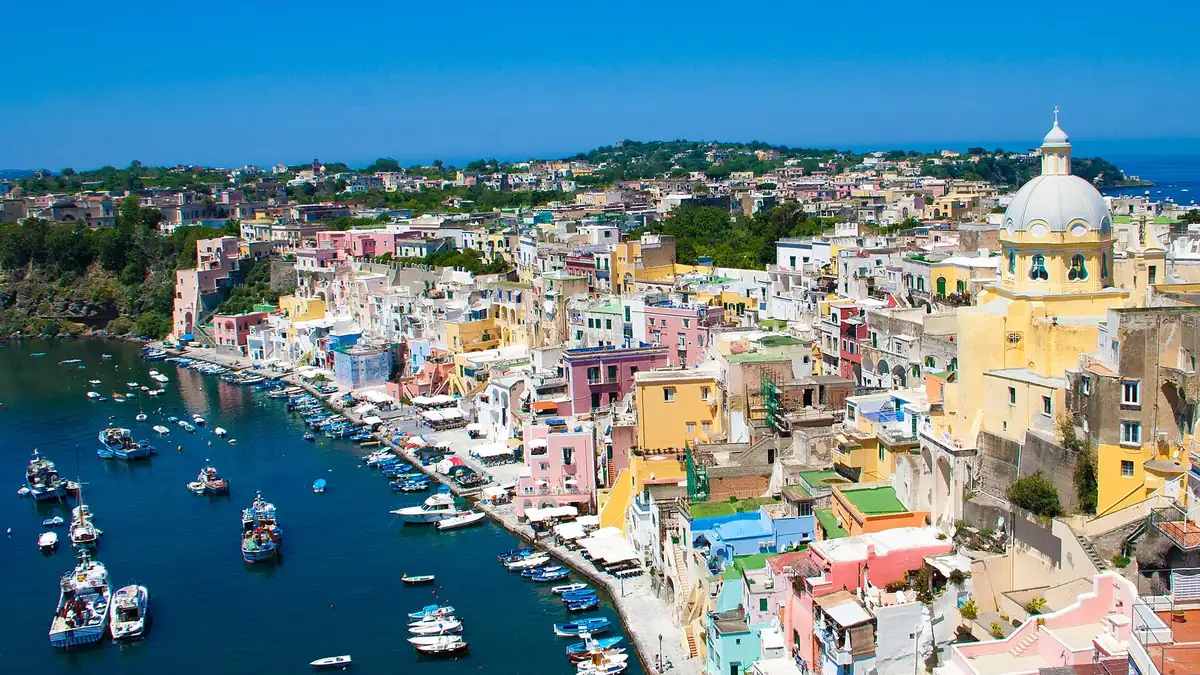
Photo: DIANA.GRYGAROVA / Wikimedia Commons, CC BY-SA 4.0.

- Hydrofoil from Molo Beverello: about 40-45 minutes.
- Ferry from Calata Porta di Massa: about 60 minutes.
It is also the smallest, and the one where a day trip actually works: you can land in the morning, cross, spend the day and come back without the whole thing feeling rushed.
How much time to leave between landing and sailing
The number that works is two hours between your scheduled landing and the boat's departure. It is not caution for its own sake — it is the sum of four real things:
- Baggage reclaim: 20-30 minutes in busy periods. If you only have cabin bags, take this off.
- Getting out and onto the Alibus: 10 minutes, plus up to 15 waiting for the next one.
- The ride: 25 to 35 minutes, longer in rush hour.
- Buying the ticket and boarding: 20 minutes, more in August when the ticket queues at Beverello are long.
Add them up and two hours is comfortable, ninety minutes is tight, and an hour means you are relying on nothing going wrong.
Booking the boat before you fly removes the ticket queue but adds a different risk: a fixed departure you cannot move if the flight is late. In high season, book. Out of season, with departures every hour or two, buying on arrival is usually the calmer choice.
Winter is a different timetable
All three routes run all year, but the summer and winter schedules are not comparable. From November to March the number of daily crossings drops sharply, the last boat leaves earlier, and on some days a route runs two or three times instead of ten.
Then there is the sea. When the weather turns, hydrofoils are suspended first — they are the most affected by waves. Ferries keep going in conditions that stop the fast boats, and are only cancelled in genuinely heavy seas. If you are travelling between December and February and the forecast is bad, the slow ferry is the one that will still sail.
Timetables change often and operators adjust them without much notice. The companies on these routes are Caremar, SNAV, Alilauro, Medmar, Alicost and NLG; check the one on your ticket the day before you travel, not a week earlier.
Luggage, and buying the ticket at the pier
Two practical things nobody mentions until you are standing there.
Luggage costs extra and gets in the way. Most island services add around 2 euro per bag on top of the fare, paid when you buy the ticket. On the hydrofoil, suitcases go in a rack by the door, not with you: get on early if you want to keep an eye on yours. And the islands themselves are built on slopes — Capri in particular means steps, narrow lanes and, in high season, a wait for the funicular. A large hard case is a genuine handicap there in a way it is not in Naples.
At the pier, the ticket office is not one window. Each company sells its own crossings, so at Beverello you are choosing between several booths, each with its own queue and its own next departure. Look at the departure boards first, pick the time, then join the right queue — not the shortest one. In August that single habit saves twenty minutes.
Coming back: the trap on the last day
Going out, a missed boat costs you a few hours. Coming back, it can cost you the flight — and this is where the airport's own closing time matters.
Naples airport closes from 22:30 to 04:00 and you cannot wait inside overnight. So the chain on your last day has to work backwards from the flight, not forwards from the island:
- last useful boat, which in winter can be mid-afternoon;
- crossing time, plus the pier-to-airport ride of 25-35 minutes;
- the two or three hours the airline wants you there before departure.
An early-morning flight out of Naples after a night on Capri is the one combination that regularly goes wrong. If your flight leaves before about 09:00, sleeping on the mainland the night before is not excessive caution — our guide to hotels near Naples airport covers the areas and the shuttle times.
Via Sorrento instead: when it makes sense
There is a second way to Capri that does not go through Naples at all: the direct coach from the airport to Sorrento, then the crossing from Sorrento to Capri, which is short and frequent in season.
It is worth considering if you are staying on the Sorrentine peninsula anyway, or if you land in the afternoon and the Naples departures are finished. It is not worth it as a shortcut — it is longer, not shorter. The coach, the fares and the timetable are in our guide to Naples airport and Sorrento.
Which island, if you have not decided
A short, honest comparison, because the three are not variations of the same place.
- Capri is the most spectacular and the most crowded. In July and August the main square is shoulder to shoulder from ten in the morning. It rewards an early boat or an overnight stay far more than a day trip.
- Ischia is much bigger, has thermal spas, real beaches and a working population, so it feels less like a stage set. It is the one that works best for a week.
- Procida is tiny, cheap to reach and the least touristy of the three. A day is enough, and that is a compliment.
With luggage and a tight schedule, the practical ranking reverses: Procida is the easiest to reach, then Ischia, then Capri.
Before you go
- Check which pier your ticket says, Beverello or Porta di Massa.
- Check the arrival port on Ischia, if that is where you are going.
- Leave two hours between landing and departure.
- In winter, check the last boat back before planning the return day.
- Fares and times here were checked in October 2026: confirm with the operator the day before you travel.
More on the airport itself, the terminal and getting around is in our Naples airport guide.
Frequently asked questions
How do I get from Naples airport to Capri?
Take the Alibus or a taxi to the port, then a boat. The Alibus costs 5 euro and reaches Molo Beverello in about 35 minutes; a taxi is a flat 24 euro. The crossing is 50 minutes by high-speed ferry from Beverello, or 60 to 80 minutes by ferry from Calata Porta di Massa.
Which port do I need, Molo Beverello or Calata Porta di Massa?
Hydrofoils and high-speed ferries leave from Molo Beverello; ferries, including the ones carrying cars, leave from Calata Porta di Massa. They are about a kilometre apart with a free shuttle between them. Your ticket says which one.
How much time should I leave between landing and the boat?
Two hours is comfortable. That covers 20-30 minutes for baggage, the wait and ride to the port of 35 to 50 minutes, and 20 minutes to buy a ticket and board. Ninety minutes is tight and an hour leaves no margin.
How much is the ferry from Naples to Ischia?
Ferries start at around 6 euro per person and take 1h15 to 1h45 from Calata Porta di Massa. Hydrofoils cost from about 15 euro and take 45 to 60 minutes from Molo Beverello. Taking a car across costs 35 to 55 euro for a vehicle under four metres.
Do the boats run in winter?
Yes, all year, but far less often. From November to March the number of daily crossings drops sharply and the last boat leaves earlier. In rough seas hydrofoils are suspended first; ferries keep sailing in conditions that stop them.
Can I do Capri as a day trip from the airport?
Yes if you land in the morning. Landing after about two in the afternoon leaves too little time, especially in winter when the last boat back is early. Check the return crossing before you commit to the outward one.
Page updated on 1 ottobre 2026. Fares and timetables change: always double-check on the official channels before you travel.