How it works at Naples airport
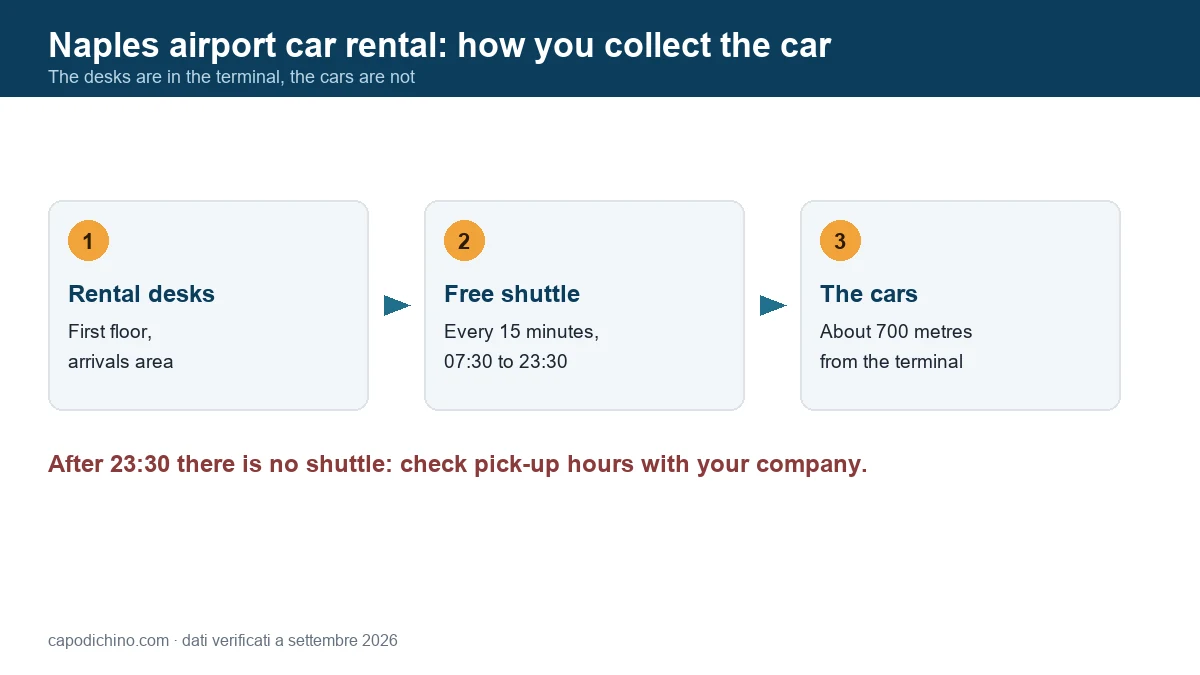
The rental check-in desks are on the first floor of the arrivals area. The cars are not there: the rental centre is about 700 metres from the terminal, reached by a free shuttle that runs every 15 minutes from 07:30 to 23:30 and leaves from the Pick-up area outside arrivals. One company, Sixt, has a desk on the ground floor of arrivals with cars in the P3 car park.
That single fact drives the whole plan:
- If you land after 23:30, the shuttle is not running. Some desks close too. Check the pick-up time with your company when you book, and if your flight is late, book a car for the next morning instead of assuming.
- Allow 30-45 minutes between leaving the baggage hall and driving away: shuttle, queue at the desk, paperwork, then checking the car.
- On the way back, build the same time into your plan, plus fuel: the shuttle back to the terminal is part of your check-in time, not extra.
The companies present at the airport include Avis, Budget, Europcar, Hertz, Maggiore, Sixt, Locauto, Drivalia, Noleggiare, Autovia, B-Rent, AutoEuropa/SicilybyCar and Centauro. The current list, with contact numbers, is on the official airport website.
What you need at the desk
- A driving licence held for the minimum period the company requires. Visitors with a non-EU licence need an International Driving Permit alongside it: get it at home before you travel, because it cannot be issued in Italy.
- A credit card in the main driver's name. Most companies block a deposit on it, from a few hundred euros up to well over a thousand for larger cars. Debit cards are often refused, or accepted only with full insurance bought at the desk.
- Your passport or ID, and the booking reference.
- Additional drivers must be present and pay a fee: adding one later is not possible from a distance.
- Under 25 or over 75? Expect a young or senior driver surcharge, and in some cases a restricted list of cars.
Insurance, in plain terms
This is where the advertised €19 a day becomes €60.
- Basic rental normally includes third-party liability and a collision damage waiver with a large excess, often €1,000-1,500. You are liable up to that amount for any damage.
- At the desk you will be offered a zero excess package. It is convenient and expensive, and it is where rental companies make their margin.
- The alternative is a separate excess insurance policy bought in advance from an independent insurer, which usually costs a fraction of the desk price. You still leave the deposit and, if there is damage, you pay the company first and reclaim afterwards.
- Tyres, glass and undercarriage are often excluded from the basic waiver. On the Amalfi Coast, where roads are narrow and walls are close, this is not a theoretical detail.
Whatever you choose, photograph the car before you leave: all four sides, the wheels, the windscreen, the roof and the fuel gauge, with the date visible. Do the same on return. Those photos settle disputes.
Fuel, tolls and extras
- Full to full is the fairest policy: you collect the car full and return it full. Avoid "full to empty" deals, where you pay for a tank at the company's price and lose whatever is left.
- Keep the fuel receipt from a station near the airport: some companies ask for it.
- Motorway tolls in Italy are paid at the barrier by card or cash; a Telepass device may be offered as an extra.
- Child seats and extra drivers cost per day, and the totals add up quickly on a two-week trip.
The ZTL: the fine that arrives months later
Italian cities restrict traffic in their centres with a ZTL, zona a traffico limitato, enforced by cameras. Naples has restricted areas, and so do most of the historic towns you may want to visit. If you drive through a ZTL without authorisation, the fine reaches you at home months later, usually with an administrative charge from the rental company for identifying you as the driver.
Three rules that avoid it:
- Never follow a satnav into a city centre without checking whether the last stretch is restricted.
- If your hotel is inside a ZTL, ask them to register your plate for the days of your stay: most can do it, but they need the number in advance.
- Park outside the centre and walk or take public transport in. In Naples this is almost always faster than driving.
On the Amalfi Coast, the coast road is narrow and busy, and in the peak season access restrictions can apply on certain days, including schemes based on number plates. Check the current rules before planning a drive along the SS163 in July or August.
Should you rent a car at all?
Honest answer: it depends on where you are going.
- Staying in Naples: almost certainly not. Traffic is dense, ZTLs are everywhere, parking is scarce and expensive, and the city has a metro, funiculars and a good bus network. Airport to centre is €5 by Alibus or €21 by taxi.
- Sorrento, Positano, Amalfi: usually not. The coast road is slow, parking at the hotels is limited and expensive when it exists, and the bus, ferry and transfer options are good. See Naples airport to Sorrento and the Amalfi Coast.
- Pompeii, Herculaneum, Caserta, Vesuvius: trains and organised trips work well, and parking at the sites is straightforward but not free.
- Cilento, Irpinia, Sannio, rural Campania, Basilicata, Puglia: yes. Public transport is thin, distances are long, and the car is what makes the trip possible.
A middle path many travellers choose: spend the city days without a car, then pick one up for the rural part of the trip, either at the airport or in town.
Driving in and around Naples: what to expect
Traffic in Naples is dense and assertive rather than aggressive: scooters filter, lanes are advisory, and hesitation causes more trouble than decisiveness. Outside the city, motorways are well surfaced and clearly signposted, and the coast roads are beautiful and slow.
Practical notes:
- Headlights on outside built-up areas, day and night, as required by law.
- Speed cameras are common on motorways and often signposted.
- Parking colours: white lines are free where they still exist, blue lines are paid, yellow are reserved. Pay at the machine or with a parking app and display the ticket.
- Never leave anything visible in the car, anywhere, including the boot when you are seen loading it.
Returning the car
Work backwards from your flight: fuel, then the drive, then the shuttle, then check-in.
- Refuel near the airport, keeping the receipt.
- Return during shuttle hours, between 07:30 and 23:30; for an early morning flight, confirm the company's opening time, because a closed desk with a key drop still needs an agreed procedure.
- Photograph the car at handover and ask for a signed check-in sheet or an emailed confirmation.
- Allow 20 minutes for the return itself and the shuttle back, on top of the standard two or three hours before the flight. All the timings are in our Naples airport terminal guide.
We are building a directory of car parks, guesthouses and licensed transfer operators around the airport. If you run one of those businesses, see the partner page.
What it costs beyond the daily rate
The advertised price is rarely the price you pay. Budget for these, because they are where a cheap booking becomes an expensive one:
- Excess insurance, either at the desk or from an independent insurer bought in advance.
- The deposit blocked on your credit card, which is not a cost but does tie up money for the length of the trip and a few days after.
- Additional driver, charged per day.
- Child seats, charged per day, unless you bring your own.
- Fuel, at Italian motorway prices if you refuel on the autostrada rather than in town.
- Tolls, which on a week touring Campania and Basilicata add up to a meaningful figure.
- Parking, both at hotels and in towns: on the coast a hotel space can cost more per day than a city car park.
A useful habit when comparing offers: take the daily rate, add the excess policy, the likely fuel and one parking space per night. The cheapest headline rate often loses.
One-way rentals and other airports
Picking the car up in Naples and leaving it in Rome, Bari or Palermo is possible with most companies, but there is a one-way fee that can be substantial, and it varies by company far more than the daily rate does. If your trip ends in another city, price both options before assuming: sometimes the train back to Naples plus a local rental beats the one-way charge.
Ferries to Sicily or Sardinia with a rental car are a separate matter: many companies do not allow it, and those that do require written authorisation in advance. Ask before you book, not at the port.
Electric cars and automatics
Two requests that need planning in this part of Italy.
Automatic transmission. Most of the Italian fleet is manual, and automatics are a smaller, more expensive category that sells out first in summer. If you cannot drive a manual, book early and confirm the transmission on the voucher rather than relying on the car category name.
Electric cars. Charging on the motorway network and in the cities is workable, but charging on the Amalfi Coast and in small hill towns is patchy, and hotel parking rarely includes a charger. If your trip is mostly rural, a hybrid is the easier compromise.
Frequently asked questions
Where are the car rental desks at Naples airport?
On the first floor of the arrivals area. The cars are about 700 metres away, reached by a free shuttle every 15 minutes from 07:30 to 23:30 from the Pick-up area, except for Sixt, whose cars are in the P3 car park.
What happens if I land after 23:30?
The rental shuttle does not run and some desks are closed. Check the pick-up hours with your company before booking, and consider collecting the car the following morning.
Do I need an International Driving Permit in Italy?
If your licence was issued outside the EU, yes: bring an International Driving Permit together with your national licence, and obtain it in your own country before travelling.
Can I rent with a debit card?
Often not. Most companies require a credit card in the main driver's name for the deposit, or accept a debit card only if you buy their full insurance package.
Is the extra insurance worth it?
The zero-excess package sold at the desk is convenient but expensive. A separate excess policy bought in advance usually costs far less; you still leave a deposit and reclaim any charge afterwards.
What is a ZTL and how do I avoid a fine?
A restricted traffic zone in a city centre, enforced by cameras. Do not follow a satnav into a historic centre without checking, and if your hotel is inside one, give them your plate number so they can register it.
Is it worth renting a car for the Amalfi Coast?
Usually not. The coast road is slow and parking is scarce and expensive. Buses, ferries and transfers cover the route well, and a car mostly adds stress.
How long should I allow to return the car?
About 20 minutes for the handover and the shuttle back to the terminal, plus refuelling, on top of the usual two or three hours before your flight.
Page updated on 18 settembre 2026. Fares and timetables change: always double-check on the official channels before you travel.